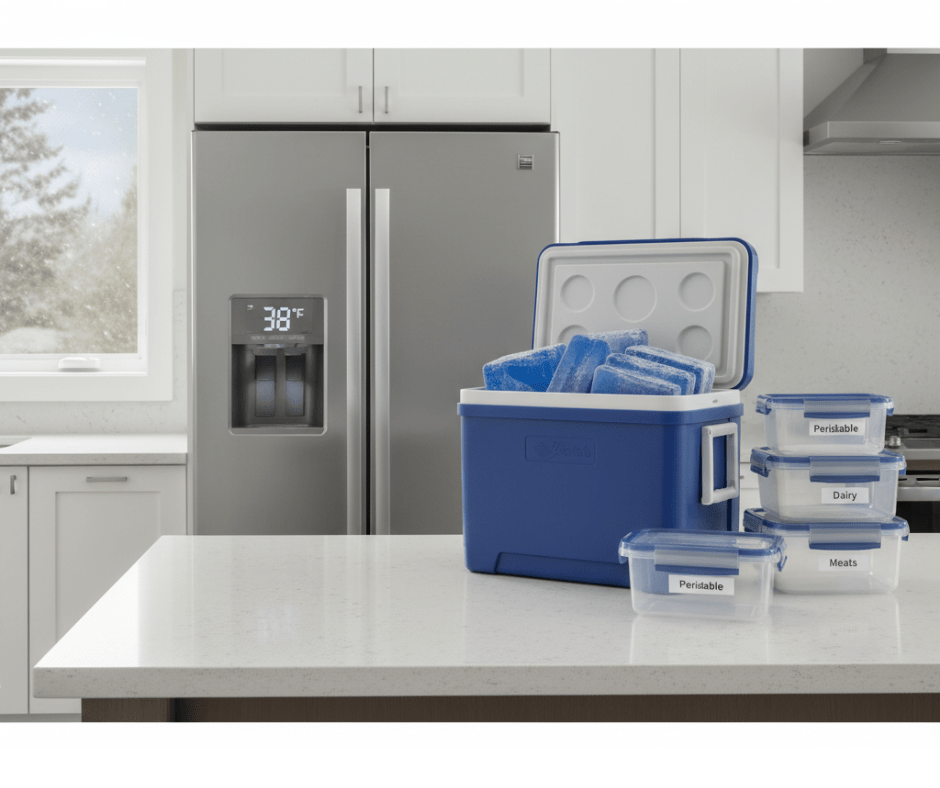
Power outages happen—storms, heat waves, accidents, snow, ice, wind—life throws them at us. When the lights go out, food safety quickly becomes a top priority. Refrigerators and freezers can keep food cold for a while, but once the temperature rises, bacteria can grow fast and make food unsafe. Knowing how long food stays good and how to handle it safely can help you avoid foodborne illness and save money.
Here’s what you need to know to stay safe and smart in a power outage.
Keep It Cold—But Know the Limits
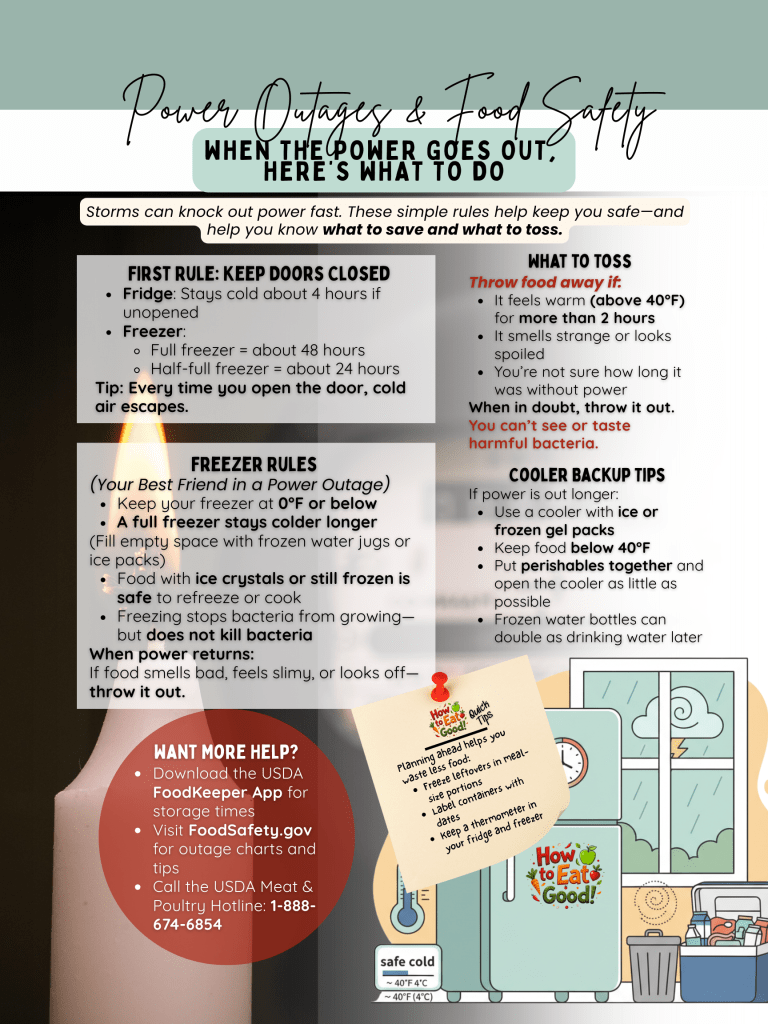
The most important rule during an outage is to keep the refrigerator and freezer doors closed as much as possible. That trapped cold air is your food’s best defense.
- Refrigerator: Food stays safe for about 4 hours if the door remains closed.
- Freezer:
- If full: up to 48 hours without power.
- If half full: about 24 hours.
After these timelines, the temperature inside will likely rise above 40°F, which allows harmful bacteria to grow quickly.
What to Do If Power Is Out Longer
If you expect the outage to last more than 4 hours:
- Use a cooler with ice or frozen gel packs to keep cold foods at 40°F or below.
- Freeze water bottles or containers of water ahead of time. These act as extra cold sources in a cooler or fridge.
- Consider buying dry ice or block ice if the outage will be extended. (Follow safety instructions on handling dry ice.)
- Cold weather can help—but use caution. During winter outages, cold outdoor temperatures may help keep food cold, but outdoor storage is risky due to temperature fluctuations, animals, and contamination. If you must use outdoor cold air, place food in a sealed, food-safe cooler and monitor temperatures carefully to be sure foods stay at 40°F or below. Never place food directly outside or in snowbanks, and do not rely on garages, porches, or car trunks without a thermometer to verify safe temperatures.
After Power Is Restored
Once the power comes back on:
- Check the temperatures. If the refrigerator is still at 40°F or below and the freezer is 0°F or below, food is safe to keep or refreeze.
- Foods that still have ice crystals or feel as cold as if refrigerated may be refrozen or cooked.
- Never taste food to check if it’s safe. Bacteria can be present even when food looks and smells fine.
What to Throw Out
When in doubt, throw it out. That’s not just a slogan—it’s real, science-based guidance because foodborne illness bacteria don’t always make themselves obvious.
Discard refrigerated perishable foods if the power was out more than 4 hours and the temperature went above 40°F. These include:
- Meat, poultry, fish, eggs, leftovers
- Dairy (milk, yogurt, soft cheeses)
- Cut fruits and vegetables
Frozen foods that have thawed completely and are above 40°F should also be discarded.
Safe Foods You Can Keep
Some items are safer because they’re naturally preserved or packed:
- Condiments with vinegar or high acid (mustard, ketchup, hot sauce)
- Jams, jellies, syrups
- Whole uncut fruits and vegetables (if they haven’t been above 40°F for too long)
Quick Safety Tips Before an Outage
If severe weather is forecast or outages are possible:
- Set your refrigerator at 40°F or below and freezer at 0°F or below.
- Freeze extra foods you don’t immediately need—leftovers, meat, milk—to make them last longer in cold storage during an outage.
- Keep a thermometer in your fridge and freezer so you can check temperatures during and after the outage.
Why This Matters
Food in the “danger zone” (temperatures above 40°F) can allow harmful bacteria like Salmonella and E. coli to grow quickly, leading to foodborne illness. You can’t rely on smell or appearance to know if food is safe—so err on the side of caution.
Bottom line:
Before an outage, plan cold sources and coolers. During an outage, keep the doors closed. After the outage, check temperatures and discard unsafe food. When in doubt, throw it out.
References
- U.S. Department of Health and Human Services — FoodSafety.gov. Food Safety During a Power Outage.
https://www.foodsafety.gov/food-safety-charts/food-safety-during-power-outage - Centers for Disease Control and Prevention (CDC). Keep Food Safe During an Emergency: Power Outages.
https://www.cdc.gov/foodsafety/foods/keep-food-safe-after-emergency.html - WKRECC. Keep Food Safe During and After a Power Outage.
https://www.wkrecc.com/keep-food-safe-during-and-after-power-outage - University of Illinois Extension. Food Safety and Power Outages.
https://extension.illinois.edu/sites/default/files/food-safety-power-outages2021.pdf
 How to Eat Good!